Peace walls
Say NothingPeace walls are barriers between Catholic and Protestant neighborhoods in Belfast, physical lines drawn across a city whose communities had long been divided by residence and daily life. First preceded by barricades during the 1969 riots, the walls helped maintain a measure of calm by keeping populations apart; decades later, they remained a visible sign that peace had not erased the divisions they were built to contain.
Geography and Existing Boundaries
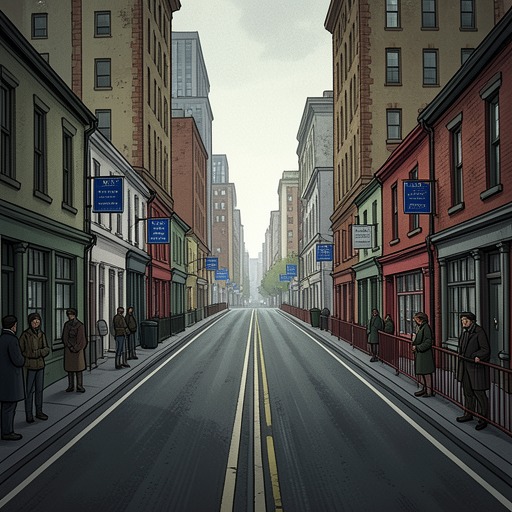
The divisions the walls formalized were already embedded in the city. The Falls Road and the Shankill Road ran roughly parallel toward central Belfast, drawing close without meeting. Narrow streets crossed between them, lined with similar terraced houses, but somewhere along each street Catholic territory gave way to Protestant territory. The city’s layout thus made the boundary both ordinary and intimate: it ran through residential streets and between neighbors, not only along some distant perimeter.
Religious identity also shaped where people lived, studied, worked, and socialized. Mixed relationships were uncommon, and crossing community lines could provoke family resentment or violence. In the 1960s, Orange Order marches began outside the McConville family home, while Ian Paisley urged Protestants to seek out Catholics living among them and drive them away. Such pressures helped turn a social boundary into a matter of physical safety. The later walls did not invent Belfast’s divisions; they gave them a more imposing form.
From Barricades to Walls
During the riots of 1969, barricades went up around neighborhoods, making sectarian geography more explicit. These temporary defenses were eventually replaced by the so-called Peace walls: towering barriers separating one community from another. Their appearance belonged to a period when normal life had been disrupted, authorities regularly raided neighborhoods, and paramilitaries policed their own enclaves. Teenage sentries watched the border lines. The Irish Republican Army, meanwhile, was poorly equipped when the riots broke out, with only about a hundred members in Belfast and some remaining weapons sold the previous year.
The walls therefore marked more than a division between communities. They belonged to a landscape in which residents organized around the possibility of violence and each side’s territory became a place to guard. Local solidarity could also take less formal forms: when authorities approached, residents alerted others by striking metal dustbin lids against the pavement, while children whistled at the first sign of trouble. The walls and these neighborhood warnings were different responses to danger, but both made the boundary consequential in everyday life.
Separation and the Maintenance of Calm
The walls’ immediate function was to separate populations and help prevent confrontations. By 2015, an account of Belfast described them as maintaining some degree of calm through physical division. That relative calm came with a cost: the barriers preserved the division rather than resolving it. At that point there were more Peace walls than at the height of The Troubles, even though Northern Ireland had been largely peaceful since the Good Friday Agreement, apart from occasional dissident attacks.
The barriers also carried the language of hostility. One side might bear K.A.T., meaning Kill all Taigs, a derogatory expression for Catholics; the other, K.A.H., meaning Kill all Huns, a reference to Protestants. The inscriptions made explicit what the walls’ architecture already conveyed: separation could limit contact while continuing to mark the other community as a threat.
Persistence After the Agreement
The walls stood within a wider pattern of continuing segregation. More than 90 per cent of children in Northern Ireland still attended segregated primary schools. In parts of Belfast, bus stops were informally designated Catholic or Protestant, and some people walked farther to wait somewhere they would feel safer. Union Jacks remained prominent in Protestant neighborhoods, while Catholic areas often displayed the Irish tricolour or Palestinian flags, expressing solidarity and, for many republicans, a sense of continued occupation.
In this setting, the Peace walls were not an isolated relic but part of a network of boundaries reproduced through schools, public space, flags, and ordinary choices about where to wait. Their continued presence holds together two truths: physical separation helped contain conflict, yet the barriers outlasted the period of extreme violence and multiplied after it. They offered calm through division, leaving the divisions themselves in view.